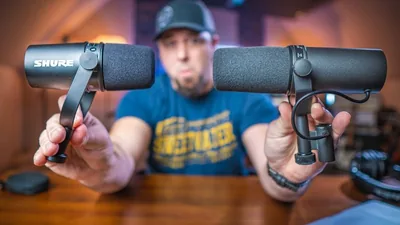
Rode PodMic vs Shure SM7B: Which Microphone Is Better?
The Rode PodMic vs Shure SM7B comparison comes down to more than choosing a cheaper or more expensive broadcast microphone. Both are dynamic cardioid XLR microphones designed to perform well when positioned close to the speaker, but their sound, versatility, controls, and ideal users are noticeably different.
The PodMic is built around accessibility. It’s a compact broadcast-style microphone with a 50 Hz to 15 kHz frequency range and a sensitivity of -57 dBV/Pa. Its focused design makes it particularly attractive for podcasts, streams, voice chat, and other spoken-word applications.
The SM7B takes a broader approach. Its 50 Hz to 20 kHz response, internal air-suspension shock isolation, electromagnetic shielding, bass roll-off, and presence boost controls give you more flexibility for professional voice recording and music production. Shure specifies a sensitivity of -59 dBV/Pa and recommends more than 60 dB of preamp gain, or an inline booster when your preamp can’t provide enough clean gain.
That distinction shapes nearly every part of the comparison.
Who Each Mic Is For
The Rode PodMic makes the most sense for podcasters, streamers, YouTube creators, and home-studio users who want a dedicated XLR microphone without putting several hundred dollars into the microphone alone.
Its biggest advantage is how much of the broadcast-mic experience it delivers at a relatively accessible price. You get a rugged all-metal body, integrated swing mount, internal pop filtering, and a cardioid dynamic capsule designed primarily around speech.
That doesn’t mean the PodMic is a beginner-only microphone. It can produce recordings suitable for serious podcasts and content production when paired with a capable interface and good microphone technique. Its limitation is more about specialization. If spoken content is almost everything you record, that specialization is an advantage.
The Shure SM7B is better suited to users who expect more from one microphone. It can serve as a podcast microphone today and a vocal-recording microphone tomorrow. Shure specifically positions it for professional speech and music applications, including studio vocals and instrumental recording.
The SM7B therefore makes more sense when recording quality is a major part of your production workflow, you’re willing to invest in supporting equipment, and you want a microphone that can remain useful as your studio expands. If you simply want excellent spoken-word audio, however, paying significantly more for that versatility isn’t automatically worthwhile.
Rode PodMic vs Shure SM7B for Real Use Cases
Specifications tell you what a microphone is designed to do. Your actual recording application determines whether those differences matter. Streaming, podcasting, and singing place different demands on a microphone, so there isn’t one winner across every situation.
Streaming
For most streamers, the Rode PodMic offers the more practical balance of performance and cost.
Streaming usually involves speaking relatively close to a microphone while a computer, keyboard, cooling fans, and other equipment operate nearby. A cardioid dynamic microphone fits this environment well because close positioning allows your voice to dominate the signal while the microphone is less sensitive to distant sounds than many studio condenser microphones.
The PodMic’s broadcast-oriented voicing also suits spoken content. Positioning it several inches from your mouth gives you a direct, present voice that can work well for Twitch streams, YouTube broadcasts, gaming, and live commentary.
You still need to pay attention to placement. A dynamic microphone doesn’t magically eliminate background noise. Keyboard sounds, desk vibration, or room reflections can still reach the recording, particularly when poor positioning forces you to add excessive gain.
The SM7B can produce more polished results and gives you additional control through its bass roll-off and presence boost switches. Its electromagnetic shielding is another useful characteristic in electronics-heavy recording environments.
The bigger question is whether those improvements justify the additional investment for a livestream whose audio may subsequently undergo compression through a streaming platform. For most creators, the PodMic is the stronger value. For professional streamers who already own a capable interface and want a premium voice chain, the SM7B has the higher ceiling.
Podcasting
Podcasting is where the Rode PodMic becomes especially difficult to dismiss.
Rode designed the microphone specifically for broadcast applications, and its compact body works particularly well in multi-microphone studios. If you’re building a four-person podcast, for example, buying four PodMics instead of four SM7Bs leaves substantially more of the production budget available for the interface, boom arms, headphones, acoustic treatment, and other equipment.
That’s important because the microphone isn’t the only factor determining podcast quality. Room acoustics, microphone technique, preamp quality, editing, EQ, compression, and consistent mic positioning can all have a substantial effect on the finished episode. An SM7B in a poorly configured setup won’t automatically outperform a well-positioned and properly processed PodMic.
The SM7B starts making more sense when you’re building a premium studio, recording commercially, or want greater flexibility from each microphone. Its smooth response, internal isolation system, effective pop filtering, and selectable frequency-response settings give engineers more options before processing even begins. The included A7WS close-talk windscreen is particularly useful when you want a warmer sound from very close microphone positioning.
For a first serious podcast setup, the PodMic is generally the smarter allocation of money. For a professional studio expected to handle many voices and recording applications, the SM7B becomes easier to justify.
Vocals
The comparison shifts toward the Shure SM7B when singing enters the equation.
The PodMic can record vocals. There’s nothing about its dynamic design that limits it to speech, and its 50 Hz to 15 kHz response covers the fundamental frequencies and much of the harmonic information required for vocal recording. But podcasting is clearly its primary territory.
The SM7B has a wider 50 Hz to 20 kHz specified frequency response and is explicitly designed for both music and speech. Its response controls also let you change how the microphone behaves before reaching for an EQ plugin. That versatility becomes useful when recording different singers.
A voice that becomes muddy with close positioning may benefit from the bass roll-off. Another vocalist may benefit from the presence boost when you want additional articulation and definition. You can also leave the microphone in its flatter setting when you prefer a more neutral starting point for processing.
The SM7B is particularly well suited to close, energetic vocals because its dynamic capsule allows performers to work close to the microphone. Its internal shock isolation and pop filtering further support demanding vocal sessions.
For occasional demo vocals, the PodMic can be perfectly adequate. If vocal production is an important reason you’re buying the microphone, the SM7B is the stronger choice.
Sound Profile Breakdown: Where You Actually Hear the Difference
The most important difference in the Rode PodMic vs Shure SM7B comparison isn’t that one microphone sounds “good” and the other sounds “bad.” Both can produce excellent speech recordings. Their presentation is different.
The PodMic tends to work best when you want a direct, focused broadcast sound without extensive preparation. Its frequency range ends at 15 kHz, compared with 20 kHz on the SM7B, although frequency-range specifications alone shouldn’t be treated as a measurement of overall sound quality.
The SM7B provides a smoother and more adaptable foundation. Its selectable bass roll-off and midrange presence boost give you three practical starting points for shaping a voice. That flexibility matters more than it might initially seem.
Low-End and Proximity Effect
Speak very close to a directional microphone, and your voice generally gains low-frequency emphasis due to proximity effect. That can create the deep “radio voice” many people associate with broadcast microphones. It can also create too much bass.
Your distance from either microphone therefore matters. Moving slightly closer can make a thin voice sound fuller, while backing away can reduce excessive low-end buildup.
The SM7B gives you an additional tool through its bass roll-off setting. Instead of relying entirely on positioning or post-production EQ, you can reduce some low-frequency emphasis directly at the microphone. That can be useful when a naturally bass-heavy voice becomes muddy during close-mic recording.
Midrange and Speech Clarity
Speech intelligibility depends heavily on the midrange and upper-midrange frequencies where much of the information that makes consonants understandable lives.
The PodMic’s voice-focused character works well here because it can give speech the forward presentation that podcasts and streams often need.
The SM7B offers more control. Its presence boost modifies the response when additional articulation is useful, while the flatter setting provides a more neutral foundation when you intend to shape the recording later.
This makes the SM7B particularly attractive in studios recording many different people. Instead of forcing every voice through exactly the same microphone response, you have some ability to adapt the microphone before software processing.
High-Frequency Detail
The PodMic has a specified upper frequency limit of 15 kHz, while the SM7B extends to 20 kHz. For spoken-word recording, that specification difference isn’t as dramatic as the numbers might suggest. Most of the frequencies responsible for speech intelligibility occur far below 15 kHz.
Where the SM7B’s broader response becomes more relevant is versatility. Singing, instruments, sound design, and professional studio recording can place more value on preserving a wider range of harmonic information. That helps explain why the PodMic makes so much sense as a specialized creator microphone while the SM7B fits into a broader professional recording environment.
Setup and Ease of Use
Neither microphone is a conventional plug-and-play USB microphone. The standard Rode PodMic and Shure SM7B both use XLR connections, so you’ll need an audio interface, mixer, recorder, or another device with an appropriate microphone input. If USB connectivity is essential, don’t confuse the standard PodMic discussed here with the newer PodMic USB, which adds USB-C connectivity alongside XLR.
The SM7B’s gain requirement deserves more attention. Shure rates its sensitivity at -59 dBV/Pa and specifically states that the microphone requires more gain than most entry-level or mid-tier preamps can provide. The company recommends a preamp capable of more than 60 dB of gain or an inline boost amplifier when necessary.
The PodMic is rated at -57 dBV/Pa, so it isn’t a particularly high-output microphone either.
In practice, don’t assume that buying the less expensive PodMic means you can ignore preamp performance. Both microphones benefit from an interface capable of supplying clean gain. This is also why microphone comparisons based only on the microphone’s retail price can be misleading.
With the SM7B especially, your real budget may need to account for the microphone, audio interface, XLR cable, boom arm, headphones, and possibly an inline gain booster. A modern interface with sufficient clean gain may eliminate the last item, but checking your interface specifications before purchasing can save you from unnecessary equipment.
Build, Mounting, and Everyday Usability
Both microphones are built for frequent use rather than occasional careful handling.
Rode gives the PodMic a stainless steel mesh grille and all-metal body. That construction makes sense for a microphone intended to sit permanently on a podcast desk or boom arm. The SM7B uses an aluminum and steel housing and an integrated yoke mount. Shure also incorporates internal air-suspension shock isolation to reduce mechanical vibration reaching the cartridge.
Neither microphone is particularly light. The SM7B weighs approximately 1.69 pounds, while the PodMic’s substantial metal construction also means you’ll want a stand or boom arm capable of securely supporting it.
The SM7B has another practical advantage for users working around computers: Shure specifically designs its shielding to reduce electromagnetic hum generated by nearby electronic equipment. That may not matter in every home studio, but it can become valuable in a workstation packed with monitors, computers, power supplies, lighting, and other electronics.
Value for Money
Value is where the Rode PodMic makes its strongest argument.
The SM7B gives you a broader professional tool. You’re paying for more than its reputation. Its wide-range response, selectable EQ characteristics, internal isolation, electromagnetic shielding, included windscreens, rugged construction, and suitability for both music and speech create genuine functional advantages.
But features only provide value when you use them. If 95 percent of your recording consists of talking into a microphone for a podcast or livestream, the PodMic can cover the core job extremely well while leaving significantly more money in your budget. That money may produce a bigger improvement elsewhere.
For example, upgrading a noisy entry-level interface, adding acoustic absorption to a reflective room, buying a sturdy boom arm, or getting closed-back monitoring headphones could improve your overall recording workflow more than spending the entire budget on a premium microphone. This becomes even more important for multi-person podcasts. The cost difference multiplies with every microphone you add.
The SM7B becomes the better investment when you know you’ll use its additional capabilities. If you record professional voice-over, podcasts, sung vocals, instruments, or client sessions with different performers, its flexibility can prevent you from needing several specialized microphones. Think about the entire recording chain rather than comparing microphone prices in isolation.
Rode PodMic vs Shure SM7B: Which Should You Buy?
The Rode PodMic vs Shure SM7B decision becomes easier once you identify what you’ll actually record.
For streaming, the Rode PodMic is the better choice for most people. It provides the focused, close-mic broadcast presentation streamers typically want without requiring an SM7B-sized microphone budget. The SM7B becomes worthwhile when streaming is part of a professional production workflow and you already have the supporting equipment to take advantage of it.
For podcasting, the PodMic wins on value. It’s especially compelling for new shows and multi-person studios where purchasing several microphones can quickly consume the equipment budget. Spending the savings on better room acoustics, interfaces, monitoring, and stands can create a more balanced setup.
For vocals, the SM7B is the clear winner. Its wider specified response, adjustable bass roll-off and presence boost, sophisticated internal isolation, and suitability for professional music recording make it much more versatile.
For an all-purpose professional studio, the SM7B also wins. It can move between spoken word and music more comfortably and gives engineers greater control over how different voices are captured.
If your priority is getting excellent spoken-word audio for the least reasonable investment, buy the Rode PodMic. If you want a microphone you can build a more serious recording chain around and use across podcasts, voice-over, streaming, and music production, the Shure SM7B justifies its higher cost.
Neither microphone makes the other obsolete. The PodMic succeeds because it delivers the qualities most content creators actually need without charging them for versatility they may never use. The SM7B succeeds because that extra versatility becomes valuable once recording moves beyond a straightforward creator setup.
That’s the real distinction in the Rode PodMic vs Shure SM7B comparison: the PodMic is the stronger value for dedicated spoken-word production, while the SM7B is the stronger long-term microphone for users who need professional flexibility across voice and music.