
Elgato Wave 3 vs Blue Yeti: Which USB Microphone Is Better?
Table of Contents
The Elgato Wave 3 and Blue Yeti have become two of the most recognizable USB microphones for creators. Both deliver excellent audio without requiring an expensive audio interface, yet they approach recording from very different philosophies.
The Blue Yeti focuses on versatility. It offers multiple pickup patterns that allow everything from solo recordings to roundtable discussions. The Elgato Wave 3, meanwhile, is designed specifically for modern creators who primarily record themselves while streaming, making videos, or hosting podcasts. It combines a high-quality condenser capsule with software features that simplify professional audio production.
Although both microphones occupy a similar price range, the better purchase depends almost entirely on how you plan to use it.
Who Each Mic Is For
Understanding the intended audience behind each microphone makes the decision much easier.
Elgato Wave 3
The Elgato Wave 3 is built primarily for creators who record themselves alone. It excels in environments where voice clarity matters more than recording multiple people. It’s an excellent choice for Twitch and YouTube streamers, gaming creators, solo podcasters, remote workers, voice-over artists, and online educators.
Its biggest advantage isn’t only the microphone itself but also Elgato’s software ecosystem. If you already use Stream Deck, Elgato cameras, or other Elgato hardware, the Wave 3 integrates seamlessly into your workflow.
Blue Yeti
The Blue Yeti appeals to users who need recording flexibility. Its selectable pickup patterns allow you to switch between:
- Cardioid for solo recording
- Bidirectional for interviews
- Omnidirectional for meetings
- Stereo for instruments and ambient recordings
This makes it especially useful for multi-person podcasts, interview creators, musicians, students, business meetings, and families sharing one microphone. If your recording situations regularly change, the Blue Yeti provides far more versatility.
Real Use Case Performance

Specifications only tell part of the story. Day-to-day recording performance is what ultimately matters.
Streaming
For streamers, the Elgato Wave 3 has a clear advantage. Its cardioid pickup pattern isolates your voice exceptionally well while reducing keyboard clicks, mouse movements, and room reflections. Combined with Wave Link software, it becomes much easier to manage game audio, Discord, music, browser sounds, and microphone levels independently without requiring external hardware.
Another standout feature is Clipguard technology. Instead of ruining recordings through clipping when you suddenly laugh or shout, the microphone automatically switches to a secondary signal path to prevent distortion.
The Blue Yeti can certainly produce excellent streaming audio, but its larger capsule tends to capture considerably more environmental noise. Mechanical keyboards, desk vibrations, computer fans, and room echo become much more noticeable unless your recording environment is acoustically treated. For untreated bedrooms and gaming setups, the Wave 3 generally delivers cleaner recordings with less effort.
Podcasting
Podcasting presents a more balanced comparison. For solo podcasts, the Wave 3 offers cleaner speech, lower self-noise, and simpler audio management through Wave Link.
However, the Blue Yeti becomes significantly more useful once additional speakers enter the conversation. Its bidirectional mode allows face-to-face interviews using one microphone, while omnidirectional mode captures group discussions around a table. Purchasing multiple microphones isn’t always necessary.
If you host guests regularly, the Blue Yeti’s flexibility is difficult to ignore. If you primarily produce solo episodes, the Wave 3 usually delivers a more polished recording.
Vocals and Voice Recording
Both microphones use condenser capsules, making them capable of detailed vocal recordings.
The Elgato Wave 3 tends to produce a cleaner, brighter sound with impressive articulation. Speech sounds crisp without becoming harsh, making it especially suitable for narration, tutorials, and professional voice work.
The Blue Yeti often sounds fuller in the low-mid frequencies. Some voices benefit from this warmer presentation, while others may require additional equalization to reduce muddiness.
For singing, preferences become more subjective. The Yeti’s fuller low-end can complement certain vocal styles, whereas the Wave 3 often produces more transparent recordings that respond well to post-processing. Neither microphone replaces a dedicated XLR studio setup, but both outperform most gaming headsets and entry-level USB microphones.
Sound Profile Breakdown
Despite both being condenser microphones, they produce noticeably different audio.
Elgato Wave 3 Sound
The Wave 3 emphasizes vocal clarity. Its sound profile generally features crisp high frequencies, excellent speech intelligibility, controlled bass response, low self-noise, and consistent proximity effect. Because the bass remains relatively restrained, voices often require less EQ before publishing.
This makes the microphone particularly attractive for creators who want professional audio immediately after plugging it in.
Blue Yeti Sound
The Blue Yeti has a richer and more colored sound signature. Characteristics include fuller low frequencies, slightly boosted lower mids, smooth high end, strong vocal presence, and more room ambience capture. Many users enjoy its radio-like warmth, although some voices can sound slightly boxy without equalization.
The microphone also responds more dramatically to distance changes, so microphone placement becomes increasingly important.
Background Noise Handling
Neither microphone is designed to reject noise like a dynamic microphone. However, the Wave 3 generally performs better because its tighter cardioid pattern focuses more directly on the speaker.
The Blue Yeti captures more of the surrounding environment due to its larger capsule and more sensitive design. For untreated rooms with hard walls, ceiling reflections, or gaming PCs nearby, the Wave 3 typically produces cleaner recordings.
Setup and Ease of Use
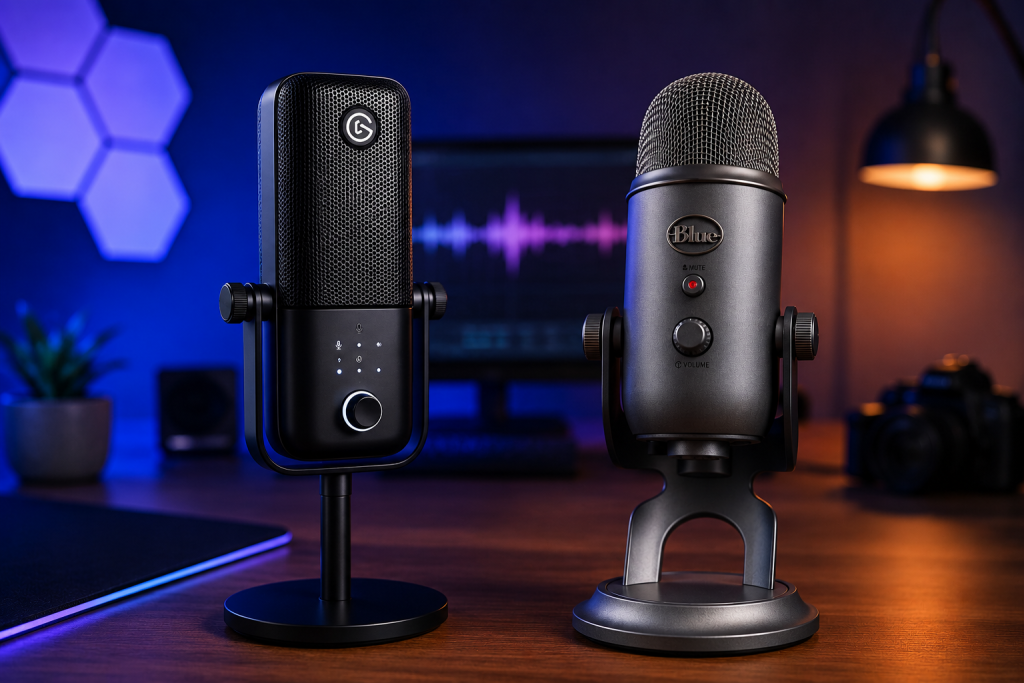
Both microphones are marketed as plug-and-play USB devices, but the user experience differs considerably.
Installing the Elgato Wave 3
The physical setup is simple. Connect the USB-C cable, install Wave Link, and select the microphone as your recording device. Wave Link quickly becomes one of the strongest reasons to buy the microphone. Instead of controlling only microphone gain, you can create separate audio channels for games, music, browser, Discord, voice chat, alerts, and system sounds.
These channels can then be mixed independently for your stream while maintaining separate monitoring mixes for yourself. For streamers, this dramatically simplifies audio management.
Installing the Blue Yeti
The Blue Yeti is arguably even simpler. Connect the USB cable and begin recording. No additional software is required to access its primary features.
Its physical controls are also excellent. The microphone includes:
- Front headphone volume
- Headphone monitoring
- Instant mute button
- Rear gain control
- Pickup pattern selector
Everything is immediately accessible without opening software. Users who prefer hardware controls often appreciate this straightforward approach.
Value for Money
The value equation depends less on price and more on how much you’ll actually use each microphone’s strengths.
The Blue Yeti remains one of the best all-around USB microphones because one purchase covers numerous recording situations. Instead of buying separate microphones for interviews, meetings, music, and solo recording, you can simply change the pickup pattern.
The Elgato Wave 3 provides exceptional value for creators whose workflow revolves around livestreaming or solo content production. Although it lacks multiple polar patterns, the included Wave Link software effectively replaces features that might otherwise require an external audio mixer or expensive routing software.
If software functionality saves you from purchasing additional equipment, the Wave 3 can represent better long-term value despite its more specialized design. On the other hand, users who simply need a dependable microphone for a variety of recording scenarios may get more flexibility from the Blue Yeti.
Elgato Wave 3 vs Blue Yeti: Which One Should You Buy?
The better microphone depends on what you create rather than which model has the longer feature list.
Choose the Elgato Wave 3 if your primary focus is livestreaming, YouTube videos, solo podcasts, voice-overs, or gaming content. It delivers cleaner voice isolation, outstanding software integration, Clipguard protection against distortion, and one of the best audio management systems available in a USB microphone.
Choose the Blue Yeti if you frequently record interviews, multiple speakers, musical performances, or different recording scenarios that benefit from switchable pickup patterns. Its flexibility remains one of its strongest advantages, making it an excellent all-purpose USB microphone.
For most solo creators, the Elgato Wave 3 earns the edge thanks to its cleaner vocal reproduction, superior software ecosystem, and creator-focused design. The Blue Yeti, however, remains an outstanding option for users who prioritize versatility over specialized streaming features.


