
Rode NT1 vs AT2020 for Vocals: Which Mic Sounds Better?
Table of Contents
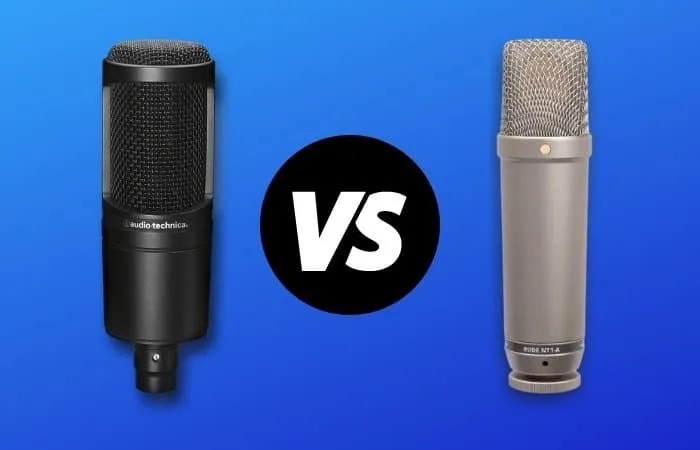
Choosing between the Rode NT1 and Audio-Technica AT2020 for vocals isn’t simply a matter of deciding which condenser microphone has better specifications. Both can produce strong vocal recordings, but differences in capsule design, self-noise, sensitivity, sound character, included accessories, and connectivity affect how they behave in a real recording setup.
The AT2020 has long been a popular entry point for singers building their first XLR recording setup. The NT1 sits higher in the market and focuses more heavily on low-noise performance, vocal detail, and studio versatility. Current NT1 models also give buyers options beyond a conventional XLR workflow.
For most vocalists, the Rode NT1 is the more capable microphone if recording quality is the priority. The AT2020 remains compelling when budget matters more, and you already have, or plan to buy, the accessories needed for vocal recording.
Rode NT1 vs AT2020 for Vocals: Quick Comparison
Both microphones are side-address cardioid condensers with a 20 Hz to 20 kHz frequency range. The similarities become less significant once you look at how they’re built and how they perform.
The standard XLR AT2020 uses a custom-engineered 16 mm low-mass diaphragm and has a rated self-noise of 20 dB SPL. It handles up to 144 dB SPL and has a sensitivity of -37 dB, or 14.1 mV/Pa. It requires 48V phantom power.
The current NT1 family uses a larger 1-inch capsule. The NT1 5th Generation, for example, has a rated 4 dBA self-noise, 142 dB maximum SPL, and -32 dB sensitivity, equivalent to 25 mV/Pa. It also supports both XLR and USB connections, with its USB implementation adding 32-bit float recording and onboard digital processing.
On specifications alone, the NT1’s major vocal-recording advantage isn’t maximum SPL. Both microphones can accommodate vocal levels comfortably in normal circumstances. Its more meaningful advantage is its exceptionally low self-noise, especially when recording quiet, intimate performances.
Who Each Mic Is For
Rode NT1: For Vocalists Who Want a More Complete Studio Mic
The Rode NT1 makes the most sense for singers who expect vocals to be a major part of their recording work. Its low noise floor becomes particularly useful when capturing breathy singing, softer acoustic performances, voice-over, layered harmonies, or recordings that may need significant compression later.
It’s also a microphone you can continue using as the rest of your studio improves. Better acoustic treatment, quieter preamps, and more experienced mixing won’t quickly expose the NT1 as the weak point in the recording chain.
The NT1 5th Generation is especially useful for musicians who don’t want to commit to one workflow. You can connect it to an audio interface through XLR or record directly to a compatible computer through USB. That flexibility can reduce the amount of equipment needed when starting a home studio.
Audio-Technica AT2020: For Budget-Conscious Home Studios
The AT2020 suits singers who want a dependable XLR condenser without paying for features they may not need. It’s particularly attractive if you already own an audio interface with phantom power.
Its relatively high self-noise compared with the NT1 doesn’t automatically make vocal recordings noisy. A strong vocal recorded at an appropriate distance will usually sit far enough above the microphone’s noise floor that the difference is less obvious in a finished mix.
The trade-off becomes easier to hear with quiet sources, aggressive compression, or sparse arrangements where there aren’t many instruments masking low-level noise.
For a first home studio, the AT2020 can therefore be a sensible way to spend more of the budget on acoustic treatment, a sturdy stand, headphones, or an audio interface rather than putting most of it into the microphone.
Real-World Vocal Performance
Technical specifications tell you what a microphone can do. Vocal performance depends on how those specifications interact with the singer, room, microphone position, and production style.
Pop and Contemporary Vocals
Modern pop vocals often need clarity and enough upper-frequency presence to remain audible through dense arrangements. The NT1 works well here because it captures considerable detail without requiring the singer to push harder simply to produce a strong recording level.
That detail also gives an engineer plenty to work with during EQ and compression. Breath, articulation, and subtle changes in vocal intensity remain easy to hear.
The AT2020 can also produce crisp contemporary vocals. Its presentation can work particularly well when you want a vocal to sound direct rather than overly thick. Good microphone positioning matters, however, because an already bright voice combined with a reflective room can make upper frequencies more difficult to manage.
Soft and Intimate Vocals
This is one of the situations where the difference between the Rode NT1 vs AT2020 for vocals becomes more significant.
A quiet singer creates less acoustic energy at the microphone. You may consequently need more gain during recording or boost the track more heavily during mixing. Compression can bring up quiet passages even further, along with the microphone’s own noise.
The NT1’s extremely low self-noise gives it an advantage in this situation. Soft phrases, breaths, and subtle vocal textures can be captured against a quieter electronic background.
The AT2020’s 20 dB SPL self-noise is considerably higher on paper. That doesn’t prevent it from recording soft vocals, but a very quiet performance in a quiet, exposed arrangement is more likely to reveal the difference.
Powerful Vocals and Belting
Maximum SPL is rarely the deciding factor between these microphones for singing.
The AT2020 is rated for 144 dB SPL, while the NT1 5th Generation is rated for 142 dB SPL. Both figures are extremely high for normal vocal recording. In practice, microphone distance, preamp gain, room reflections, and plosives are likely to require attention before a singer approaches the microphone’s acoustic SPL limit.
A powerful singer should focus more on placement. Moving several inches farther from the capsule can control level while allowing the voice to develop naturally. A pop filter also provides a useful visual reference that helps maintain a consistent distance.
Sound Profile Breakdown
Microphone specifications can’t completely predict how a particular voice will sound. Two singers can use the same microphone in the same room and come away with very different impressions.
Rode NT1 Sound
The NT1 is designed around a smooth, detailed studio sound. Rode describes the current NT1 character as combining warm bass, a detailed midrange, and smooth or sparkling high frequencies, depending on the specific NT1 model.
For vocals, that generally makes it useful when you want a full-range recording that leaves plenty of options for processing afterwards. The extended low end can capture the body of deeper voices, while the high-frequency response preserves articulation and air.
That detail has another consequence. Like most sensitive condenser microphones, the NT1 can expose weaknesses in an untreated recording space. Reflections, computer fans, traffic, air conditioning, and other background sounds may become part of the recording.
AT2020 Sound
The AT2020 is often useful when the goal is a clean, straightforward vocal capture at a relatively low cost. Its smaller 16 mm diaphragm and transient response help it capture articulation without requiring elaborate setup.
The microphone doesn’t offer onboard tone controls, pads, or filters on the standard XLR version. What reaches your interface is essentially the microphone’s raw output, leaving EQ, compression, de-essing, and filtering to the recording or mixing stage.
That simplicity isn’t necessarily a disadvantage. Beginners can learn more about microphone technique and processing when they’re working from a relatively uncomplicated signal chain.
Self-Noise Matters More Than Many Beginners Realize
The NT1’s low self-noise is one of the strongest technical distinctions in this comparison.
The AT2020 is rated at 20 dB SPL of noise, while the NT1 5th Generation is rated at just 4 dBA. Those figures shouldn’t be interpreted as a simple percentage difference, since decibels use a logarithmic scale.
More importantly, microphone self-noise isn’t the only source of noise in a home recording. Your room, computer, HVAC system, audio interface, cables, and outside environment can all contribute.
If your recording space has an audible fan running three feet away, buying a quieter microphone won’t remove that fan. In fact, a sensitive condenser may capture it very clearly.
The NT1’s noise advantage becomes most valuable after you’ve controlled the recording environment. Once the room itself is quiet, the microphone can capture low-level vocal detail without adding as much electronic noise of its own.
Sensitivity and Gain Requirements
The NT1 5th Generation has a specified sensitivity of 25 mV/Pa, compared with 14.1 mV/Pa for the AT2020. In practical terms, the NT1 produces a stronger electrical output for the same acoustic pressure. That means you generally won’t need as much preamp gain to reach a useful recording level with the NT1.
Neither microphone is unusually difficult to drive. They’re condenser microphones rather than low-output dynamic mics, so a typical modern audio interface should provide adequate gain.
Gain still needs to be set according to the actual singer. Don’t try to hit the highest possible level. Leave enough headroom for unexpectedly loud notes, especially when tracking singers with a wide dynamic range.
The NT1 5th Generation offers another option through USB. Its digital system supports 32-bit float recording, which provides considerably more flexibility for recovering levels in compatible recording workflows. It doesn’t make microphone placement irrelevant, and it can’t prevent distortion caused by physically exceeding the capsule’s maximum SPL, but it can make digital level management more forgiving.
Setup and Ease of Use
Using the AT2020
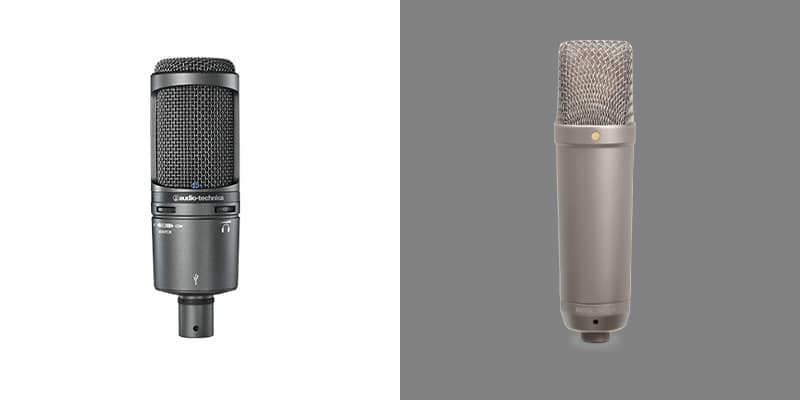
The standard AT2020 is an XLR condenser microphone. You’ll need an audio interface or another compatible preamp that supplies 48V phantom power.
Audio-Technica includes a pivoting stand mount, threaded adapter, and protective pouch. For serious vocal recording, you’ll generally want to add a pop filter and possibly a shock mount.
A pop filter is particularly important when positioning a condenser close to a singer. It reduces bursts of air from consonants such as “p” and “b” before they hit the capsule.
Using the Rode NT1
The exact setup depends on which NT1 you buy. Current XLR-only versions work much like a conventional studio condenser, while the NT1 5th Generation offers both XLR and USB connectivity.
The 5th Generation model can therefore operate as part of a traditional interface-based studio or connect directly to a computer. Its USB mode also provides access to digital processing features such as a high-pass filter, noise gate, compressor, and Rode’s APHEX processing.
For vocalists who don’t own an interface, this can significantly change the value calculation. Comparing microphone prices alone doesn’t account for the equipment required to create a complete recording chain.
Room Acoustics Can Matter More Than the Mic Upgrade
Buying the NT1 instead of the AT2020 won’t automatically produce professional vocals in a poor room.
Both are cardioid condensers, meaning they’re designed to be most sensitive to sound arriving from the front while reducing sound from the rear. Cardioid rejection helps, but it doesn’t eliminate room reflections.
Hard walls, bare floors, windows, and empty corners can create early reflections that make vocals sound hollow, harsh, or distant. Those reflections are recorded with the voice and can be difficult to remove convincingly afterwards. This is why a cheaper microphone in a controlled space can outperform a more expensive microphone in a reflective bedroom.
Positioning helps even without permanent acoustic treatment. Keep the microphone away from bare walls and corners, reduce nearby reflective surfaces, and place absorption behind and around the singer where practical.
Mic Distance and Technique for Better Vocals
Start around 6 to 12 inches from either microphone and adjust from there based on the singer and desired sound.
Moving closer increases the direct-to-room ratio and can create a fuller low-frequency sound because cardioid microphones exhibit proximity effect. Get too close, however, and plosives, mouth noises, and excessive bass become harder to control.
Moving farther away produces a more open vocal sound and can help powerful singers, but it also captures more of the room.
Don’t treat microphone position as something you set once and forget. Moving the microphone a few inches can sometimes improve a vocal more effectively than several EQ adjustments later.
Angle also matters. If sibilance is aggressive, positioning the microphone slightly off-axis can soften direct high-frequency energy without requiring the singer to change technique.
Which Mic Is Easier to Mix?
The answer depends heavily on the voice, but the NT1 generally provides a cleaner starting point when the recording itself is quiet and well controlled.
Its low noise is especially useful when using compression. Vocal compression reduces dynamic range, which often means quieter details become more audible after makeup gain is applied. Any noise recorded with those details becomes more noticeable too.
The AT2020 can still fit into a mix with standard processing. High-pass filtering can remove unnecessary low-frequency rumble, subtractive EQ can address resonances, and compression can stabilize vocal levels. A de-esser may help if the combination of the singer and microphone produces prominent sibilance.
Don’t assume a more expensive microphone should require no EQ. Microphone selection gets you closer to the desired starting point, but processing remains a normal part of vocal production.
Value for Money
The AT2020’s strongest argument is straightforward: it gives you a genuine studio condenser microphone without demanding a large microphone budget.
That matters because a recording setup is a system. Spending less on the microphone can leave room in the budget for an interface, headphones, stand, pop filter, cables, and basic acoustic treatment. If you’re starting from nothing, those purchases can collectively improve your recordings more than putting nearly the entire budget toward one microphone.
The NT1 becomes easier to justify when vocal recording is a long-term priority. Its exceptionally low noise, larger capsule, higher sensitivity, and more comprehensive vocal-recording package make it less likely that you’ll want to replace it simply because your studio improves.
The NT1 5th Generation adds another dimension to the calculation. Its USB connection and integrated digital recording features can potentially eliminate the immediate need for a separate interface in some setups.
Rode NT1 vs AT2020 for Different Vocalists
A bright or naturally sibilant singer shouldn’t choose purely from a frequency-response specification. Microphone distance, off-axis positioning, room acoustics, and the individual voice all affect the result. Testing both microphones with the actual singer remains the most reliable comparison when that’s possible.
Deep voices can benefit from the NT1’s full-bodied capture, particularly when a production calls for intimate low-mid detail. At the same time, working too close to either cardioid microphone can exaggerate bass through proximity effect.
For rappers and spoken vocals, both microphones offer enough transient detail to preserve consonants and articulation. The NT1’s lower noise can become particularly valuable for spoken passages with pauses, exposed intros, or heavily compressed vocal chains.
For singers who record demos, covers, or occasional vocals at home, the AT2020 may already provide everything necessary. The extra performance of the NT1 becomes more meaningful as recording conditions and production expectations improve.
Rode NT1 vs AT2020 for Vocals: Which Should You Choose?
The Rode NT1 vs AT2020 for vocals comparison comes down to how much you expect from your recording setup.
The AT2020 makes sense when you want an affordable, uncomplicated XLR condenser for home recording. It handles high sound levels, covers the full audible frequency range, and can produce polished vocals when paired with good technique and a suitable recording environment. Saving money on the microphone can also free up budget for room treatment and other equipment that has a direct impact on recording quality.
The Rode NT1 is the stronger option when low noise, sensitivity, vocal detail, and long-term versatility matter more. It’s particularly well suited to soft singing, exposed vocal arrangements, voice-over, layered productions, and sessions where substantial processing may reveal the noise floor. The NT1 5th Generation also makes the setup more flexible by combining traditional XLR connectivity with direct USB recording.
If you’re building a first studio on a tight budget, the AT2020 provides a practical foundation. If vocals are central to your work and you want a microphone with more room to grow alongside your recording skills and studio, the NT1 offers meaningful advantages you’ll continue to use.
Frequently Asked Questions
Is the Rode NT1 better than the AT2020 for singing?
The Rode NT1 has several technical advantages for serious vocal recording, particularly its much lower self-noise and higher sensitivity. Those qualities are especially useful for quiet singers, exposed arrangements, and heavily processed vocals. The AT2020 remains capable of producing strong vocal tracks when paired with good microphone technique and a controlled room.
Is the AT2020 good enough for professional vocals?
The AT2020 can produce usable professional-quality recordings when the singer, room, placement, interface, and engineering are good. A microphone’s price doesn’t establish the quality of the finished recording by itself. More expensive microphones may provide lower noise, different tonal characteristics, or additional features, but performance depends on the entire signal chain.
Is the Rode NT1 good for soft vocals?
Yes. Soft vocals are one of the applications where the NT1’s extremely low self-noise is particularly valuable. Quiet performances often require more gain or processing, making microphone noise easier to hear.
Does the AT2020 need phantom power?
The standard XLR AT2020 requires 48V phantom power. Most modern recording interfaces provide it, but you should confirm that your interface or preamp has phantom power before buying the microphone.
Does the Rode NT1 need an audio interface?
It depends on the model. An XLR NT1 requires a suitable audio interface, mixer, or preamp for computer recording. The NT1 5th Generation can connect through XLR or directly to a compatible computer via USB, so an external audio interface isn’t required when using its USB output.
Which microphone is better for an untreated room?
Neither microphone solves poor room acoustics. Both are sensitive cardioid condensers that can capture reflections and background noise. Close positioning and careful room placement can reduce these problems, but basic acoustic treatment usually produces a larger improvement than simply switching between the two microphones.


![The Future of Microphones [Unveiled]](https://www.shout4music.com/wp-content/uploads/2024/03/pexels-skitterphoto-33970-768x509.jpg)


