
SM7B vs MV7 for Podcasting: Which Shure Mic Should You Choose?
Table of Contents
The Shure SM7B and MV7 are often compared because they occupy similar visual and practical territory. Both are dynamic cardioid microphones designed to work well with voices, both reward close microphone placement, and both can handle podcasting, streaming, and vocal recording. They aren’t simply expensive and affordable versions of the same microphone, though.
The SM7B is a traditional XLR studio microphone built around a professional analog workflow. Its smooth frequency response, strong off-axis rejection, internal shock isolation, and tonal controls have made it a fixture in broadcast studios, recording rooms, and professional podcasts. Shure specifies a 50 Hz to 20 kHz response and provides bass roll-off and presence boost controls for adjusting its character.
The MV7 takes a more creator-focused approach. It combines a dynamic cardioid capsule with USB and XLR connectivity, headphone monitoring, software controls, and Voice Isolation Technology. You can plug it directly into a computer or incorporate it into a conventional XLR setup later.
For most people comparing the SM7B vs MV7 for podcasting, the choice comes down to one question: do you want maximum studio flexibility or maximum convenience?
Who Each Mic Is For
The SM7B makes the most sense for creators who already have, or intend to build, a proper XLR recording setup. It’s particularly well suited to established podcasters, recording studios, professional streamers, voice-over artists, and musicians who want control over the entire signal chain. The microphone itself performs one job: capturing sound. Your interface, preamp, mixer, plugins, and recording software handle everything else.
That modular approach is part of its appeal. You can pair the SM7B with different preamps to suit your workflow, route it through hardware processing, record through a professional interface, and apply detailed EQ or compression later. It doesn’t depend on proprietary software to provide its core functionality.
The MV7 is aimed more directly at independent creators who want excellent voice capture without assembling a complete studio around the microphone. You can connect it through USB, monitor through headphones plugged directly into the mic, and manage settings through Shure’s software. Its XLR output also means you aren’t permanently locked into a USB workflow. That makes the MV7 particularly attractive for solo podcasters, home streamers, remote workers, YouTubers, and beginners who want room to upgrade.
In simple terms, choose the SM7B if you want to build your recording system around the microphone. Choose the MV7 if you want the microphone to handle more of the recording system for you.
Real Use Case Performance
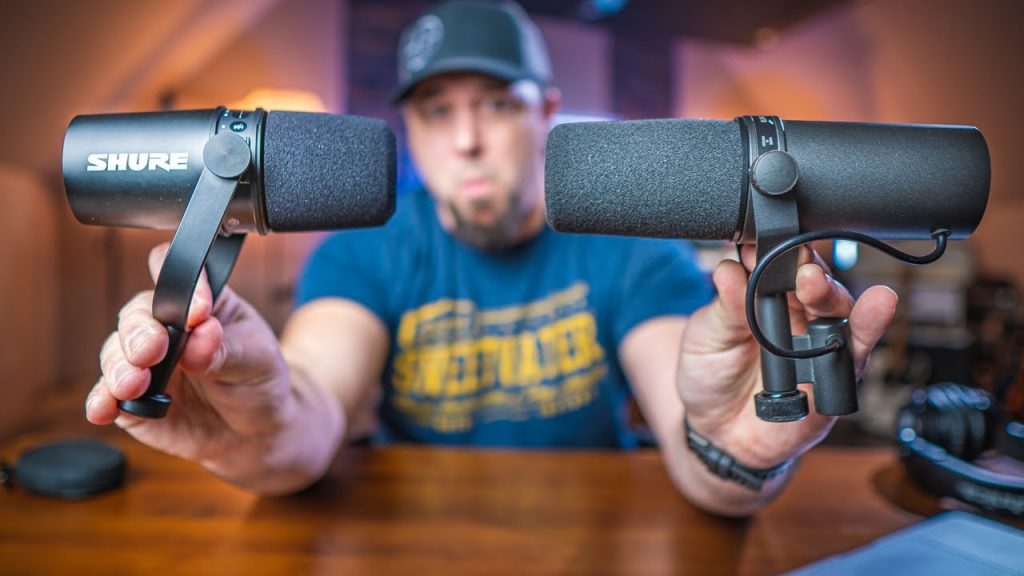
Specifications only tell part of the story. The differences become much more obvious when the microphones are placed into actual recording environments.
Streaming
For streaming, the MV7 has an immediate practical advantage.
A streamer can connect it directly to a computer through USB, plug headphones into the microphone, select it in streaming software, and start working without buying an audio interface. Shure’s Voice Isolation Technology is designed to focus capture on sound arriving directly in front of the mic, which suits close-positioned desktop use.
That simplicity matters more than it might seem. Streaming setups already involve cameras, lighting, capture cards, keyboards, controllers, monitors, OBS scenes, chat applications, and sometimes gaming hardware. Removing an extra audio interface from the chain makes troubleshooting easier.
The MV7 is also easier to move between setups. Someone streaming from a laptop can use USB, while a creator with a more advanced mixer can connect the same microphone through XLR.
The SM7B is excellent for streaming once the surrounding equipment is in place. Its cardioid pattern provides strong rejection of off-axis sound, while its internal air-suspension shock isolation helps reduce mechanical noise reaching the cartridge. Shure also designed it with shielding against electromagnetic interference from nearby equipment. Those characteristics suit a desktop environment filled with computers and electronics.
The issue is that an SM7B can’t simply connect to your computer. You’ll need an audio interface or mixer with enough microphone gain. Shure recommends at least 60 dB of preamp gain for typical voice-over applications. For a professional streamer who already uses an audio mixer or interface, that’s unlikely to be a problem.
For someone building a first streaming setup, the MV7 is considerably easier.
Winner for streaming: MV7 for most users. SM7B for established, XLR-based streaming setups.
Podcasting
The SM7B vs MV7 for podcasting comparison is much closer.
The SM7B excels in a dedicated podcast studio. Its relatively smooth and natural response gives producers a flexible recording that can be shaped during post-production. Shure describes the microphone as having a flat, wide-range response designed for clean reproduction of both speech and music. That makes it especially useful when each podcast host has a separate processing chain.
One speaker might need additional presence. Another may need low-frequency reduction. A producer can record relatively natural source material and make those decisions later. The microphone’s physical bass roll-off and presence boost switches also provide some basic tonal adjustment before external processing begins.
The MV7 is less demanding. Its USB connection makes it one of the more practical options for a one-person podcast. Instead of buying a microphone, interface, XLR cable, and potentially additional gain hardware, you can connect the mic directly to a computer.
Built-in headphone monitoring also makes recording easier because you don’t need another device simply to hear your microphone without relying on delayed software monitoring. For interviews recorded outside a permanent studio, that simplicity becomes even more useful. A laptop, microphone, headphones, cable, and compact stand can form a functional portable podcast setup.
There’s another advantage for new podcasters: the MV7 can grow with the show. If you later move into a multi-microphone studio with a dedicated mixer or interface, you can use its XLR output instead. Shure notes that the passive XLR signal isn’t affected by the microphone’s software settings, so it can function as a conventional analog microphone in that configuration.
For a single host or portable podcast, the MV7 usually makes more sense. For a fixed professional studio with a producer handling audio, the SM7B has the advantage.
Winner for podcasting: MV7 for solo and home podcasters. SM7B for higher-end studio production.
Vocals
For music vocals, the balance shifts toward the SM7B. The SM7B isn’t limited to speech. Shure positions it for both music and spoken-word applications, and its broad 50 Hz to 20 kHz frequency response gives it considerably more flexibility than a microphone designed exclusively around podcast speech.
Its smooth character works particularly well when you don’t want a microphone exaggerating the upper frequencies of a vocal. That can be useful for singers with naturally bright, aggressive, or sibilant voices. You can capture a relatively controlled signal and shape the vocal afterward using EQ, compression, saturation, or other processing.
The SM7B also handles close vocal work well. Its built-in pop filtering and included close-talk windscreen help control plosives, while its internal shock isolation reduces vibration transmitted through the stand.
The MV7 can absolutely record singing. For demos, home recordings, social media covers, songwriting sessions, and casual vocal production, its simplicity can actually make it more useful. You don’t have to build a dedicated vocal recording chain before getting a usable track.
It just isn’t as compelling as the SM7B when music recording becomes the priority rather than an occasional secondary use. The SM7B gives producers a more neutral starting point and integrates naturally into an established studio environment.
Winner for vocals: SM7B.
Sound Profile Breakdown
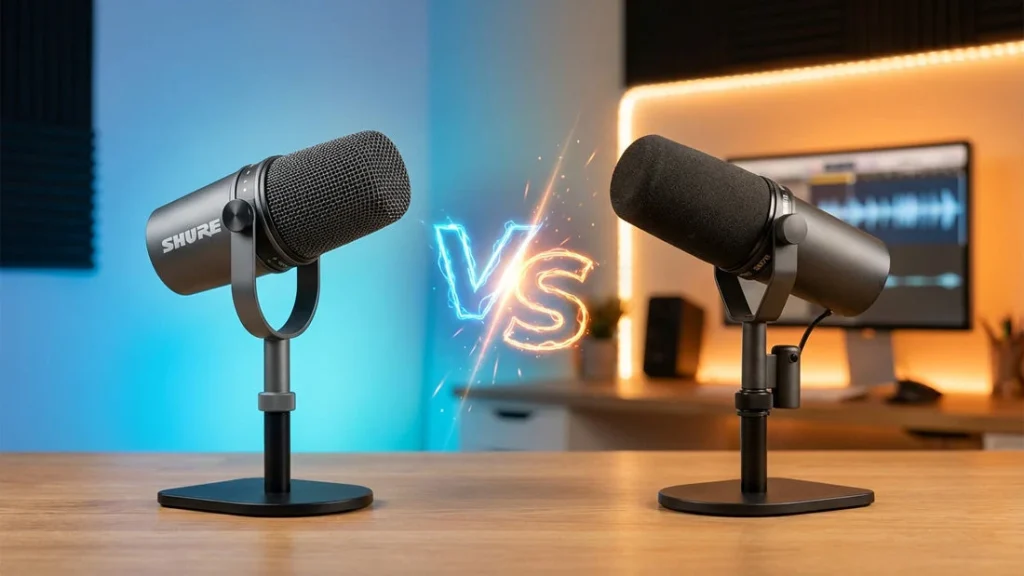
The biggest sonic difference between these microphones isn’t simply that one sounds “better.” They have different design priorities.
SM7B: Smoother, Fuller, and More Natural
The SM7B generally produces the smoother and more studio-oriented sound of the two. Its frequency response is relatively controlled rather than aggressively sculpted for instant vocal presence. That can give voices a fuller, more relaxed quality, particularly when the microphone is positioned correctly and connected to a good preamp.
The low end can sound substantial when speaking close to the microphone because of the proximity effect. That can create the deep broadcast sound many people associate with the SM7B, but too much proximity can make some voices sound muddy.
The bass roll-off switch gives you a way to reduce some of that low-frequency emphasis. There’s also a presence boost setting. Shure describes it as adding brightness through the midrange to help improve vocal clarity. Leaving both controls flat gives you the most neutral starting point.
That flexibility is one reason engineers like the SM7B. You can decide how polished, bright, compressed, or broadcast-like you want the finished voice to sound during production.
MV7: More Immediate and Voice-Focused
The MV7 is designed to get to a finished spoken-word sound more quickly. Its Voice Isolation Technology focuses on the person speaking directly into the mic, making the microphone particularly suitable for podcasts and desktop content creation.
Compared with the SM7B, the result can feel more immediately present and speech-focused. That can be helpful for podcasting because vocal intelligibility matters more than perfectly neutral reproduction. You may need less work to get the recording into the general tonal territory expected from podcasts, YouTube narration, and streams.
The trade-off is that the SM7B gives experienced producers more freedom to shape the original recording.
Which Sounds More Professional?
The SM7B has the higher ceiling when the rest of the recording chain is equally strong. That doesn’t mean an MV7 automatically sounds amateurish.
Microphone placement, speaking technique, room acoustics, gain staging, EQ, compression, loudness normalization, and editing can easily matter more than the difference between these two microphones.
A well-positioned MV7 recorded six inches from the speaker in a reasonably controlled room can sound substantially better than an SM7B positioned too far away and fed through a noisy preamp. The SM7B becomes most impressive when the entire setup allows it to perform properly.
Setup & Ease of Use
This category has a decisive winner. The MV7 is much easier to set up. USB allows you to connect it directly to a compatible computer without buying a dedicated audio interface. The microphone also provides a headphone monitoring output, reducing the amount of hardware required on your desk.
Its XLR connection remains available if you eventually want to introduce an interface or mixer. That combination makes troubleshooting simpler. If your podcast isn’t recording properly, there are fewer devices, cables, gain stages, and routing settings to investigate.
The SM7B requires more planning. It uses a three-pin XLR connection and produces a relatively low output level of -59 dBV/Pa. Shure recommends a microphone preamp with at least 60 dB of gain for typical voice-over recording.
Some modern interfaces can provide enough clean gain without assistance. Others can’t. If your preamp doesn’t provide sufficient gain, Shure notes that an inline phantom-powered preamp can add approximately 25 to 28 dB. That introduces another component into the chain.
A typical SM7B computer setup therefore looks something like this: SM7B → XLR cable → audio interface or preamp → USB connection → computer.
The MV7 can simply be: MV7 → USB connection → computer.
That difference matters enormously for beginners and portable setups. It matters much less in a professional studio where an interface, mixer, monitors, and XLR infrastructure already exist.
The SM7B is also relatively heavy, so pairing it with a strong boom arm or microphone stand is advisable. Shure lists the microphone at well over a pound, depending on the published specification reference.
If you want something you can connect quickly and use with minimal audio knowledge, the MV7 is the clear winner.
Winner for setup and ease of use: MV7.
Value for Money
Value depends heavily on what equipment you already own.
The MV7 offers better value for someone starting from scratch. You’re getting the microphone along with USB audio conversion, XLR connectivity, headphone monitoring, and software integration in one device. That reduces the number of separate products needed to create a working recording system.
The SM7B needs to be evaluated as part of a complete setup rather than as a standalone purchase. You need an interface or mixer with sufficient gain. If the preamps can’t drive the microphone cleanly, you may need additional amplification. You’ll also need an XLR cable and a sturdy mounting solution. That can make the total entry price considerably higher.
However, value changes if you already own those components. Someone with a capable interface, quality preamps, good headphones, and an established recording workspace isn’t paying to build the supporting system again. For that person, the SM7B becomes a much easier investment to justify.
Its simple analog design also gives it strong long-term utility. You’re not dependent on USB standards or software compatibility to continue using the microphone. As long as you have a suitable XLR preamp, the SM7B remains functional.
The MV7 partially shares that advantage because its XLR connection gives it a useful fallback even if you eventually stop using its USB features. For most new podcasters, though, the extra equipment needed for an SM7B could often be better spent elsewhere.
Acoustic treatment, a solid microphone arm, closed-back headphones, backup storage, or better editing software may improve your complete production more than allocating most of your initial budget to the microphone itself.
Winner for value: MV7 for most creators. SM7B for users who already own a capable XLR setup.
Final Verdict: SM7B vs MV7 for Podcasting
There isn’t one winner for every creator, but there are clear winners for specific situations.
For podcasting, the MV7 is the better choice for most people. Its USB connectivity removes the need for a separate interface, headphone monitoring is built in, and its XLR output gives you a straightforward upgrade path. A solo creator can start with a simple desk setup and later integrate the same microphone into a more advanced studio.
For professional podcast studios, the SM7B takes the lead. Its smooth frequency response, analog simplicity, physical bass and presence controls, strong off-axis rejection, internal shock isolation, and compatibility with professional signal chains give experienced producers more control over the finished recording.
For streaming, choose the MV7 unless you already have a mixer or audio interface that can comfortably drive the SM7B. For vocals, choose the SM7B if you’re serious about recording music and want greater flexibility during mixing. For portable recording, choose the MV7. For a permanent studio, choose the SM7B if your budget and supporting equipment allow it.
For beginners, choose the MV7. For experienced audio producers who want maximum control, choose the SM7B.
The core difference in the SM7B vs MV7 for podcasting comparison is therefore straightforward: the MV7 gives you more functionality inside the microphone, while the SM7B gives you more freedom outside it.
The MV7 is the stronger all-around buy for most podcasters because it’s easier to use, less expensive to build around, and flexible enough to transition from USB to XLR. The SM7B wins when you’re willing to invest in the complete recording chain needed to take advantage of what it does best.


